

AI in advertising: What marketers need to know to stay ahead

TL;DR: Everything to know about AI-powered advertising
- AI-powered advertising uses artificial intelligence and machine learning to analyze data, create content, and optimize advertising campaigns.
- Tools like StackAdapt’s Creative Builder use AI to help teams generate, adapt, and resize ads faster, reducing the time it takes to launch campaigns.
- Human oversight remains critical, particularly for brand safety, creative quality, and governance, as consumer expectations rise.
In a few short years, AI has transformed nearly every aspect of advertising.
Whether it’s executing behind-the-scenes processes like forecasting campaign performance, optimizing bidding strategies, and identifying high-value audiences, or streamlining everyday creative tasks like generating ad copy, images, and videos, AI is reshaping how advertising campaigns are planned, executed, and scaled.
These days, marketers can create thousands of creative assets, run controlled A/B tests, and autonomously manage campaigns—all within a single, AI-powered advertising platform.
Yet, despite its rapid advancement, AI adoption remains uneven.
According to a study by StackAdapt and Ascend2, only 39% of agencies have significantly integrated AI into their day-to-day workflows, and 18% have barely scratched the surface.
But as customer journeys grow increasingly fragmented and marketers are expected to handle more with less, AI is becoming central to how marketing teams operate—allowing them to automate repetitive tasks, reduce manual overhead, and free up time to focus on what matters most: building meaningful connections with customers.
Read on to learn how AI is being applied across advertising and how to use it (the right way).
What is AI in advertising?
AI in advertising uses AI-driven technologies, such as machine learning and natural language processing, to automate, optimize, and improve campaign performance. It does this by analyzing and interpreting large, real-time and historical datasets to identify predictive performance signals, helping marketers generate ad creative, manage bids and budgets, target audiences, predict outcomes, and measure results with greater precision.
In doing so, AI makes it possible to deliver more personalized, timely, and relevant advertising at a scale and efficiency that was previously impossible with human effort alone.
How is AI used in advertising?
AI is used in advertising to analyze data, streamline campaign decisions, generate creative variations, and ultimately improve how ads are targeted, delivered, and measured. Common applications include:
- Audience targeting: Machine learning models can analyze audience, contextual, behavioral, and campaign signals to help identify relevant audiences and environments.
- Contextual targeting: Natural language processing can evaluate the meaning, sentiment, and structure of page content to help place ads in relevant, brand-suitable environments.
- Campaign optimization: AI advertising platforms can monitor performance signals and support decisions around bids, budgets, pacing, frequency, and ad delivery.
- Creative generation: Tools like ChatGPT, StackAdapt’s Creative Builder, and Adobe Firefly can help create AI-generated ad copy, images, storyboard concepts, and videos that marketers can further test and refine.
- Creative optimization: Dynamic creative tools can match elements like headlines, images, calls to action, or local promotions to different audiences, contexts, or channels, improving campaign performance.
- Measurement and forecasting: Predictive analytics can identify patterns and forecast likely outcomes based on prior ad performance, surfacing recommendations for future optimizations.
- Brand safety and fraud detection: Programmatic platforms often use machine learning, manual reviews, and third-party verification to help identify placements near harmful or off-brand content, suspicious traffic patterns, or other issues that could undermine brand trust or waste media spend.
What are the benefits of AI in advertising?
For brands and agencies alike, AI is fundamentally changing how ad campaigns are planned and run. Here’s where it delivers the most impact:
More precise targeting
In the past, targeting in digital advertising largely came down to finding the right audience attributes, be it their age, geographic location, income level, or professional role.
But due to increased privacy regulations, ongoing signal loss, and shifting consumer behavior, that approach is no longer enough.
As a result, although many advertisers previously relied on identity-based signals to enhance ad targeting and audience segmentation, marketers are increasingly turning to contextual targeting solutions, like StackAdapt’s Page Context AI, which analyzes page-level language, themes, and sentiment in real time. This allows brands and advertisers to move beyond surface-level attributes and connect with audiences based on what they’re actively engaging with in that moment.
“The ad is showing up on the website, not because of information that you have about the user, but because of the website’s content,” says Ned Dimitrov, VP of Data Science at StackAdapt, speaking with The AI Advertising Podcast. “This turns out… to be highly effective in getting the brand message into the user’s mind.”
That insight is backed by independent research.
A study from Nielsen previously found that combining contextual signals with behavioral data leads to stronger advertising effectiveness than relying on either approach alone, reinforcing the role context plays in effective targeting.
Better decision-making through predictive analytics
As media budgets face increased pressure and customer journeys become more fragmented, relying solely on historical performance is no longer enough. Predictive analytics allows marketers to look ahead, using insights from past performance and real-time data to anticipate how campaigns are likely to perform before they’re even launched.
With predictive modeling, AI evaluates millions of signals to forecast performance indicators such as potential engagement, optimal bid values, and the likelihood of conversions. This shifts real-time bidding and campaign optimization from a reactive process to a predictive one, helping teams identify high-value opportunities and allocate spend where it’s most likely to deliver the best results—whether that’s a click, sign-up, or purchase.
In doing so, teams gain more efficient use of their media budgets, more consistent performance across campaigns, and faster feedback loops, which ultimately improve forecasting and optimization.
Increased efficiency through automation
AI allows marketing teams to execute and optimize campaigns at a scale and efficiency that wasn’t previously possible.
By automating often tedious and time-consuming tasks such as creative versioning, bid and budget adjustments, and performance analysis, AI can accelerate workflows that would often take days (if not weeks or months) to execute.
In doing so, AI reduces operational overhead and drag, allowing brands and agencies of all sizes to stretch their budgets further and save time to focus on more strategic, high-impact initiatives.
Optimized campaign management, ad delivery, and spend
AI plays a critical role in optimizing how and where ads are delivered. By continuously analyzing performance data across channels, platforms, and formats, AI can identify what’s working, what’s not, and recommend strategic adjustments, allowing marketers to improve performance without relying on manual guesswork.
AI can even automatically manage bids, campaign pacing, and budget allocation to ensure ad spend is directed toward the types of audiences, placements, and formats most likely to drive results. This allows campaigns to dynamically adjust based on signals like timing, inventory availability, and creative performance, so teams spend less time on day-to-day optimization tasks.
Stronger brand safety and fraud prevention
As advertising becomes more automated and distributed across channels, the risk of fraud and brand-adjacent harm increases. As a result, protecting brand reputation and media spend has become just as important as driving performance.
Once again, AI is playing a central role in programmatic advertising, analyzing page-level context, traffic patterns, and behavioral signals to identify unsafe environments and flag non-human activity before it impacts campaigns. This includes detecting invalid traffic, blocking fraudulent clicks, and preventing ads from appearing alongside inappropriate or misaligned content that could undermine brand trust.
“In today’s ecosystem, brand safety is really about making sure your ads don’t show up next to content that could harm your reputation—whether that’s hate speech, misinformation, violent content, or maybe just stuff that’s off-brand,” says Connie Yan, Director of Platform Quality at StackAdapt. “Within natural language processing, large language models are proving to be particularly powerful. [Their] ability to understand context, nuance, and even sentiment in text [can be done] at a much deeper level. This allows for more accurate identification of potentially brand-damaging content.”
In doing so, AI helps ensure campaigns run in environments that align with brand values while protecting budgets from wasted spend. For marketers, that means greater confidence that media investments are not only efficient, but also credible, compliant, and appearing in brand-safe environments.
Faster (and more effective) creative production
Creating ad creative—like ad copy, images, and creative variations—has always been a resource-intensive process.
AI is easing that burden by helping teams generate, adapt, and iterate on content faster—and at greater scale—without sacrificing quality or consistency.
“[With AI], we can produce 50 headlines as quickly as we could historically produce one,” says James Targett, Creative Project Manager at StackAdapt. “We’ve tracked performance metrics like click-through rates, and AI-generated copy often outperforms client-supplied and internally written content.”
External research also backs this up.
A recent study conducted by Columbia University, Harvard University, Technical University of Munich, and Carnegie Mellon University found that AI-generated ads delivered a higher CTR (0.76%) than human-made ads (0.65%).
But there’s a catch: Ads that looked AI-generated—whether or not they actually were—performed worse overall, indicating that perceived artificiality is what can weaken performance, not the use of AI itself.
Rather than replacing human creativity, Targett says AI should be about collaboration, using it “to generate volume quickly, then refining the best outputs with a human touch” to drive stronger results.
In practice, this allows teams to create and test more ideas faster, rather than being constrained by production bottlenecks—giving them more time to focus on their marketing strategy and refine messaging to drive performance. More on that below.

Generative AI Is reshaping ad creation
More relevant personalization
Personalization has long been a goal in advertising, with an oft-cited McKinsey report finding that 71% of customers expect companies to understand their unique needs and expectations. But historically, personalization in digital marketing was difficult to do, especially across multiple channels, without adding significant complexity.
AI is changing that, in part by helping marketers tailor messaging based on what actually motivates different audiences. By analyzing page-level context, historical responses to creative variations, and audience-level engagement patterns, AI can identify which messages resonate with different segments and adjust creative accordingly.
The good news: even when AI-generated ad creative is used for personalization, consumers as a whole respond positively to this approach. A recent study found that AI ad copy tailored to individual personality traits was more persuasive than generic messaging, and audiences didn’t mind the fact that the content was generated by AI—proving again that relevance, not authorship, is what ultimately drives impact.
Improved measurement and ROI tracking
Measuring performance and proving ROI has long been one of the most complex challenges in digital advertising. AI-powered analytics are changing that by giving marketers clearer, more actionable visibility into what’s driving results across channels.
Because AI can continuously monitor campaign activity, support cross-channel attribution, and provide deeper audience insights, teams can better understand how different touch points contribute to conversions, lift, and overall performance across channels.
Case in point: StackAdapt’s recent study, The State of Personalization in Digital Marketing, found that 79% of brands that have fully integrated AI across channels say they can more accurately measure the revenue impact of personalization. For brands not using AI at all, that number falls to just 14%.
In doing so, AI gives marketers the visibility needed to identify issues earlier, make informed optimizations, and apply learnings to future campaigns with confidence—something that would be difficult, if not impossible, to achieve manually.
How AI-powered ad creative tools are providing content generation at scale
As demand for personalized, visually engaging ads continues to grow, creative production has become a bottleneck for many teams.
One of the most promising and practical applications of AI in advertising is the use of generative AI for creating ad copy, images, and video across creative formats.
A recent survey of CMOs found that AI-powered text generation is one of the most widely used AI applications in B2B marketing, but adoption is expanding quickly into other formats, with a January report from the Interactive Advertising Bureau (IAB) finding that 86% of media buyers either currently use or plan to use AI to build AI-generated video ads in 2026. More recently, a report from Advertiser Perceptions found that 73% of US advertisers now use AI to create images for display banner ads and social posts.
To better support this shift, StackAdapt’s Creative Builder, enhanced by Ivy™, brings AI-assisted creative production directly into the platform. It allows teams to generate and modify creatives using AI—whether that means creating AI-generated ads from text prompts, enhancing existing assets by removing or replacing background images, or adapting creative for different formats through automated resizing and motion effects—all in a fraction of the time typically required by traditional creative workflows.
With an expanded library of templates and self-serve creative tools, teams can build, test, and launch ads faster while maintaining brand consistency. In doing so, it reduces the reliance on external design resources, minimizes ad fatigue caused by repeatedly running the same assets, and accelerates time to market without sacrificing quality.

The ongoing shift toward scalable content creation isn’t just about producing more assets, though. It’s also about reshaping how creative is delivered.
According to Acxiom’s 2024 CX trends report, nearly half (47%) of consumers say they prefer it when brands recommend products based on their personal preferences.
Rather than treating ads and campaigns as fixed assets, AI is increasingly being used to adapt creative based on who’s seeing it and when through dynamic creative optimization (DCO).
With DCO, a single creative can be automatically transformed into hundreds or even thousands of variations, adjusting elements like messaging, imagery, format, or product recommendations in real time to match audience intent and context.
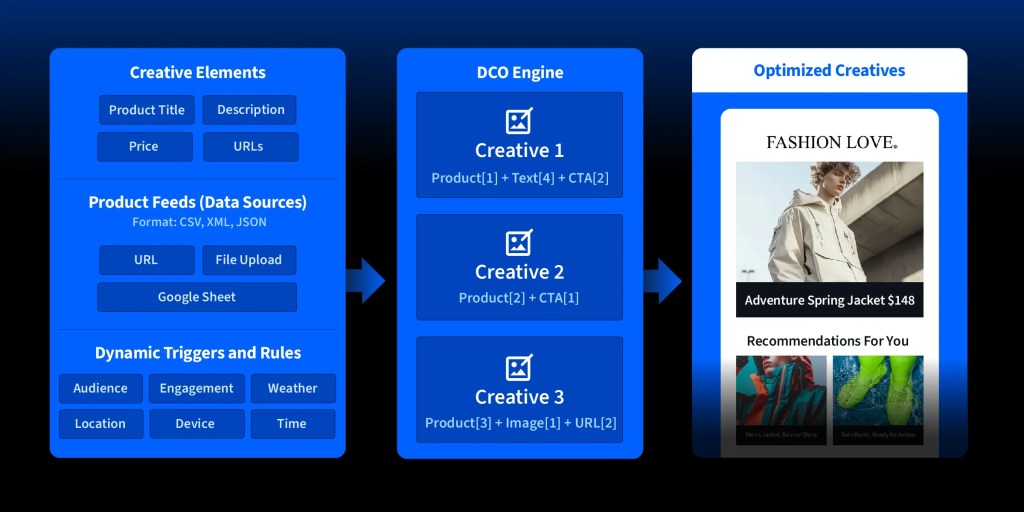
In StackAdapt, self-serve DCO uses AI to dynamically assemble creative, drawing from live product feeds and campaign inputs to deliver the most relevant message for each opportunity.
Instead of manually testing versions, the platform identifies what resonates most with different audiences and scales those variations instantly, delivering the right product or message at the right moment while maintaining consistency across channels.
As a result, ad creative can be personalized without requiring teams to manage thousands of individual assets.
Tools & platforms: How to choose the right AI advertising tech
Back in 2011, when Scott Brinker—VP of Platform Ecosystem at HubSpot—published his first Marketing Technology Landscape Supergraphic, a visual representation of all the marketing technology (commonly known as martech) in the industry, only 150 solutions were included in the inaugural chart.
Fast-forward 14 years, and 15,384 solutions made the 2025 edition—many of them powered by AI.
With so many adtech and martech tools to choose from, it can be difficult to know which tools are worth investing in, let alone understand what separates one from the other.
Here are a few of the top AI advertising tools you should consider when planning your next campaign:
- OpenAI’s ChatGPT, Microsoft Copilot, or Google Gemini for drafting copy, briefs, or marketing plans.
- Grammarly for editing copy for grammar, style, tone, and spelling mistakes.
- Midjourney and Adobe Firefly for creating AI-generated ads and editing images for paid media and display campaigns.
- Canva’s Magic Studio for assembling, resizing, and adapting ad creatives across formats and channels.
- OpenAI’s Sora for generating short-form AI video ads or creative concepts for video and social media advertising.
- StackAdapt’s AI-powered advertising and orchestration platform for planning, activating, and optimizing campaigns across channels (including email and programmatic direct mail).
- Semrush’s AI Visibility Toolkit for monitoring brand presence and AI search optimization.
- Claude Code and Replit for building, testing, and iterating on internal tools or applications to support reporting, automation, and creative experiments.
- Zapier for building customized workflows and automating repetitive tasks.
How to get started with AI in programmatic advertising
Getting started with AI in advertising doesn’t require a full transformation on day one. The most effective approach is incremental: identify one or two areas where AI can remove friction, then build from there.
“A really good question to start with is, ‘What’s actually painful for you?’” says Matt Travers, Managing Director at BRAIVE, an AI advisory and implementation firm based in Australia, speaking on a recent episode of The AI Advertising Podcast. “From there, it’s about unpacking why that pain exists—where the process breaks down, where it holds up—and then using AI to help automate what matters most.”
For many teams, that starting point is creative production, targeting, bidding, or measurement—places where manual processes already slow campaigns down or introduce inconsistency.
But before selecting tools or testing features, it’s important to align internally on what success looks like. That means defining clear goals, identifying existing bottlenecks, and agreeing on how AI is expected to support, not replace, current workflows.
Here are some steps to help you get started:
1. Establish your goals
AI works best when it’s applied to a specific problem. Whether the goal is improving targeting, accelerating creative production, or strengthening attribution, choosing the right objective (not to mention KPIs) can help you focus your efforts and evaluate whether AI is actually improving performance.
2. Choose the right tools
With no shortage of AI-powered tools on the market, the question shouldn’t be which platform has the most features, but which platform makes the most sense in your existing workflows.
The most effective AI advertising tools reduce manual effort, improve decision-making, and integrate easily with how you already plan, launch, and measure your campaigns.
If you need advice, talk to peers in your network or look at independent reviews, like G2 reports, to see how different tools and platforms perform for different use cases.
3. Test first, then scale
AI-powered workflows should be introduced through controlled tests, not broad rollouts. Start with a defined test—one objective, one variable, and a clear evaluation window—to help isolate the impact of using AI in your advertising efforts. This helps you understand how AI behaves under real conditions, rather than assuming results based on product demos or high-level industry benchmarks.
4. Upskill your team
Many teams struggle with AI—not because the tools are lacking, but because guidance is limited or unclear. Case in point: LinkedIn’s B2B Marketing Benchmark found that 43% of marketers cited a lack of in-house AI skills as the biggest barrier to adopting generative AI.
Training should focus on how to frame prompts and briefs, interpret outputs critically, and understand when human judgment should intervene.
To close that gap, look for courses or training programs that focus on applying AI within real marketing workflows.
5. Avoid common pitfalls
The most common mistake teams make is trying to do too much at once. Broad mandates to “use AI everywhere” often lead to fragmented strategies and unclear results.
Starting small, documenting learnings, and continuing to test new tools and workflows will help teams use AI deliberately, rather than forcing AI into workflows where it doesn’t provide much value.
Challenges and solutions for AI in advertising
As AI becomes a more common part of advertising, it also increases the risk of missteps in how campaigns are planned, executed, and governed.
Why AI requires stronger guardrails in advertising
According to a study from StackAdapt and Ascend2, the biggest concerns that agencies had about using AI in advertising were:
- Data privacy and compliance (32%)
- Brand safety, AI bias, and ad fraud (27%)
- Balancing automation with personalization (27%)
- Ethical considerations (18%)
These concerns were echoed in a separate survey on AI risk conducted by the International Association of Privacy Professionals (IAPP), which included respondents ranging from trade groups like the Association of National Advertisers to large organizations such as Salesforce and self-regulatory bodies like the Children’s Advertising Review Unit. Across the group, several risks surfaced repeatedly, including algorithmic bias, hallucinations, data privacy concerns, uncertainty around AI-generated content, and intellectual property issues.
Human oversight still matters
The fix? Keeping humans in the loop—a popular concept that emphasizes clear oversight and accountability, especially as AI takes on a larger role in campaign execution.
“The real conversation isn’t AI vs. humans—it’s AI and humans working together,” says Yang Han, CTO and Co-founder of StackAdapt. “AI excels at data-driven tasks, automation, and predictive analytics, but it lacks human intuition, creativity, and ethical judgment.”
That means building clear guardrails into AI workflows and pairing automation with ongoing human review. Many organizations—including Salesforce, PwC, and the IAB—emphasize setting boundaries on what AI can generate, regularly auditing outputs after deployment, and training teams to verify results, flag issues, and escalate potential risks.
Despite increased awareness of these challenges, a report from the IAB found that while over 70% of marketers have encountered an AI-related issue—such as hallucinations, bias, or off-brand content—fewer than 35% plan to increase investment in AI governance or brand integrity oversight in 2026.
But this kind of structured oversight, supported by expert reviewers, can help catch subtle bias or hallucinations early and ensure AI continues to perform as intended.

Where do advertisers draw the line with AI?
Avoiding the uncanny valley
The same principle applies to the use of AI for building AI-generated ad creative.
In 2023, nearly 60% of consumers said they felt comfortable with brands using AI in advertising. By 2024, that figure fell to 46%. Later that year, nearly two-thirds of consumers said they felt uneasy about how AI is being used in advertising (with skepticism highest among older generations, particularly Gen X and Baby Boomers). Now, that skepticism appears to be extending to younger audiences, too, with a recent report finding that 39% of Gen Zers dislike AI-generated ad creative—nearly double that of Millennials.
They’re not alone.
According to a global survey, 54% of marketing decision-makers worry that overreliance on AI could erode the human creativity that helps ads resonate with audiences.
The reason: AI-generated ads can sometimes fall into an “uncanny valley,” where visuals or messaging feel almost human—but not quite—making ads feel distracting or inauthentic rather than engaging.
The solution: use AI to accelerate ideation and variation, while keeping humans responsible for curation, refinement, and final creative decisions.
“AI can help in the ideation phase, like storyboarding multiple concepts quickly,” says Te’Shawn Dwyer, a manager of StackAdapt’s in-house Creative Studio team. “But when brands skip human curation, the results can feel cold and impersonal.”
Practical guidelines for using AI in advertising
According to Kantar and the IAPP, brands that apply clear governance and human oversight to AI-driven creative are more likely to maintain trust and avoid the perception that automation has come at the expense of authenticity.
To put that into practice, agencies and brands should keep a few core principles in mind:
- Stay in the driver’s seat: Use AI to support specific campaign objectives, not as a shortcut to replace strategic thinking or creative direction.
- Train AI to be on brand: Feed AI models clear guidance on tone of voice, visual identity, and brand guidelines to ensure your brand identity shines through.
- Take a people-first approach: Go beyond surface-level engagement metrics and assess whether AI-generated creative is evoking the intended emotional response.
- Make AI feel seamless, not distracting: If generative AI creatives draw attention to themselves rather than the message, that’s a clear sign further refinement is needed.
- Test continuously and use humans to review the results: Regular testing and audits help ensure AI-driven creative is landing as intended, on-brand, and brand safe.
The real ROI of AI in advertising
If you’re still skeptical about AI’s role in advertising performance, the data below helps put its impact into context.
Where AI in advertising is delivering real results
According to internal StackAdapt platform data featured in our recent advertising trends report, The State of Programmatic Advertising 2026:
- Advertisers see up to 2X higher return on ad spend (ROAS) when using 1st-party data or AI-based contextual targeting compared to 3rd-party targeting.
- Campaigns using DCO deliver a 32% higher CTR.
- Advertisers using DCO achieve a 56% lower cost per click.
These gains aren’t isolated to a single channel or tactic—they reflect broader shifts in how AI is being applied across modern marketing organizations.
Evidence from across the advertising industry
Multiple studies point to similar performance and efficiency gains when AI is integrated thoughtfully into marketing workflows.
- A McKinsey study found that 24% of marketing and sales teams reported revenue gains of 6% or more from AI over the past year.
- 93% of brands and 94% agencies say that AI is improving the speed and efficiency of programmatic marketing workflows (The State of Personalization in Digital Marketing).
- A case study found that by using StackAdapt’s DCO to dynamically tailor product ads based on shopper behavior, Vallo Media was able to re-engage cart abandoners, driving a 60% lift in CTR and generating 30% of total ad-attributed revenue with just 12% of their campaign budget.
Together, these examples show how AI can improve performance, efficiency, and measurement, especially when it’s applied with clear intent and oversight.
ROI depends on people, not just platforms
LinkedIn’s Work Change Report found that AI literacy is becoming a priority at the executive level, with 37% of C-suite leaders saying investment in learning and development to train employees on AI tools will be key to accelerating adoption over the next year.
The report also found that developing generative AI skills strengthens broader human capabilities, not just technical proficiency. Employees building generative AI skills are:
- 13X more likely to develop change-readiness skills.
- 9X more likely to strengthen trust-building abilities.
- 5X more likely to improve logical reasoning.
In other words, AI skills and human skills tend to develop together. Successful AI adoption depends as much on people as it does on technology.
What is the future of AI in advertising?
As AI adoption matures, the focus is shifting from what the technology can do to how it’s being applied in practice—automating repetitive tasks, improving decision-making, and reducing friction across once-complicated workflows.
Here’s where those shifts are already taking shape and what’s emerging next:
LLM advertising moves from niche to norm
In the past, consumers primarily scanned through search results, articles, review sites, and online forums when deciding what to do, what to buy, and where to go.
Now, those moments of discovery are increasingly happening inside AI tools like ChatGPT, with people asking questions, researching products, and comparing options in a single conversation.
According to McKinsey, half of consumers use AI-powered search to research and discover products and services today. At the same time, EMARKETER reports that AI chatbots are expected to help 63.3 million US shoppers in 2026.
ChatGPT ads give marketers a way to reach people during these everyday moments. As a result, it’s no surprise that LLM advertising is emerging as one of the fastest-growing advertising channels, with global spending expected to surpass $101 billion USD by 2030.
Through advertising platforms like StackAdapt, marketers can access ChatGPT ads through the tools and processes they already use—helping them launch and manage campaigns while connecting AI-powered search to a broader media strategy across programmatic channels.
Speak with our team to learn more.
Agentic AI takes on more campaign execution
The old ways of manually managing programmatic campaigns are giving way to more automated, AI-assisted workflows. Agentic AI is beginning to take on more of the work, with applications spanning everything from campaign planning and media buying to ad placement and optimization across digital channels.
Whether providing end-to-end campaign management or strategic advice on how to improve performance, AI agents capable of independent reasoning and executing complex tasks are shifting the role of the media buyer from hands-on campaign manager to strategic orchestrator.
Tasks that used to take weeks—like data analysis, media planning, and campaign reporting—can now be done in a few minutes with agentic AI tools, freeing up teams to spend more of their time on strategy and higher-impact decision-making.
Adoption is still early, but interest is growing quickly. According to the IAB, two-thirds (66%) of US ad buyers plan to pay closer attention to agentic ad buying this year, with 41% of US and UK marketers saying the biggest benefit of agentic AI in advertising will come from optimizing toward cost per acquisition and ROAS goals.
AI enhances brand safety in programmatic advertising
AI is already changing how brands think about brand safety, but not simply as a way to avoid risk—as a way to make previously inaccessible inventory more viable.
In channels like programmatic podcast advertising, the availability of transcripts has opened the door to far more granular analysis than was ever possible with manual review alone. Now, AI can analyze hundreds or thousands of shows and episodes at once, allowing marketers to assess the context of conversations, themes, and potential risks at a depth that lets brands invest in inventory that was previously too opaque or time-intensive to evaluate confidently.
Looking ahead, more advanced models will be able to account for cultural nuance and brand-specific definitions of safety. But the real progress will come from operationalizing these capabilities transparently, so teams can clearly see how and where brand safety decisions are being applied.
Campaign orchestration becomes more predictive
Marketing orchestration is another area where AI’s role is expanding, though not toward full automation just yet.
Data from StackAdapt shows that marketers seeing the strongest revenue gains are significantly more likely to be making major investments in AI, and nearly twice as likely to expect AI to meaningfully disrupt how campaigns are orchestrated.
AI-generated bid strategies, recommended budget reallocations, and performance simulations are becoming more common, helping teams anticipate outcomes rather than react to them.
While humans still set objectives and constraints, AI is increasingly used to model scenarios, surface opportunities, and guide decision-making—bringing orchestration closer to a predictive discipline without removing human oversight.
Creative production accelerates
Creative workflows are also evolving, with AI playing a larger role in the areas where speed, iteration, and scale create the most value.
Rather than running campaigns end to end, AI is accelerating the workflows marketers already rely on, such as creative variation, testing, resizing, and optimization—especially for motion and video formats.
Internal data from the StackAdapt Creative Studio found motion- and video-based creative production grew 59% year-over-year, reflecting rising demand for formats where AI-assisted editing and personalization can be applied immediately.
Adoption patterns reinforce this shift. Usage of StackAdapt’s AI marketing assistant, Ivy™, and Page Context AI shows marketers increasingly turning to AI to streamline planning, asset generation, and optimization tasks.
As teams mature, AI will continue to gain traction in creative iteration, audience refinement, and predictive optimization, improving speed and consistency without replacing strategy or creative judgment.
Retail media measurement matures
Over the past few years, retail media has been one of the fastest-growing channels, and it isn’t expected to slow down, with global ad spending projected to grow 52.6% over the next five years. But measurement hasn’t always kept pace, making it harder for marketers to understand what’s actually driving performance.
One of the most consistent challenges has been understanding performance across different retail media networks, especially when reporting standards, attribution windows, and transparency can vary widely.
AI is starting to change that by giving marketers more flexible ways to understand campaign performance.
Instead of simply reporting which ads drove a conversion, AI can analyze audience behavior, creative performance, timing, product demand, and channel activity to help explain why certain campaigns performed the way they did, while others fell short.
Over three-quarters (86%) of commerce media decision-makers in North America and Europe say improving measurement and attribution to better prove ROI is a high or critical priority over the next year. As AI-powered measurement tools become more widely adopted, retail media reporting will become less fragmented and more useful—providing clearer insight into what worked, what didn’t, and what to optimize next.
Harness the power of AI in your advertising strategy
If it’s not clear already, AI is reshaping how advertising is planned, executed, and measured. But the real impact of AI—now and in the future—won’t come from isolated features, but from how it’s operationalized across connected workflows.
“Over the last decade plus of the evolution of martech, there’s been a number of clear leaders in a very fragmented ecosystem—whether it’s marketing automation or customer data platforms or programmatic advertising,” says Vitaly Pecherskiy, CEO and Co-founder of StackAdapt. “[But] none of these systems talked to each other. They all were siloed.”
Historically, that fragmentation has limited what AI can actually do in practice. But, as Pecherskiy explains, the next phase is about bringing those systems together so AI can inform decisions across planning, creative, activation, and measurement, instead of being confined to individual tools:
“If we believe that the future will be in convergence of all these ecosystems… to be able to use AI to navigate all these functional areas to unlock better decision making, these systems need to converge in the first place.”
Request a demo to explore how StackAdapt helps advertisers apply AI across the entire advertising lifecycle, and stay up to date with where AI in programmatic advertising is headed by listening to The AI Advertising Podcast. Subscribe on Apple Podcasts and Spotify.
Next steps:
- Learn where AI in marketing is headed and how it’s set to evolve in the future.
- Watch this webinar to get expert-backed tips on building a ChatGPT advertising strategy.
- Explore StackAdapt’s AI-powered advertising and orchestration platform and sign up to start using it today.
AI in advertising FAQs
AI can help manage paid advertising campaigns by automating repetitive tasks, analyzing performance data, and recommending or making adjustments to bids, budgets, targeting, and creative decisions. It can also support faster testing by generating multiple ad variations, identifying which messages are performing best, and surfacing patterns that would be difficult to find and interpret manually. That said, AI works best when marketers set the strategy, review recommendations, and define clear guardrails, not when campaigns are left to run on autopilot.
AI optimizes advertising spend by analyzing campaign performance signals and shifting budget toward the audiences, placements, and channels most likely to drive results. Instead of relying on manual adjustments, AI can adjust bids, pacing, and targeting in real time—reducing wasted impressions, improving budget efficiency, and spending more where campaigns are most likely to deliver the strongest results.
The main ethical considerations of using AI in advertising include transparency, accuracy, bias, privacy, and accountability, especially when AI is used to create ad copy, images, or video.
Without documented human-in-the-loop output verification and bias audits, AI-generated ads risk unintentionally misleading consumers, reproducing biased or unrealistic representations, or including elements that resemble third-party intellectual property. Brands are legally mandated to provide explicit disclosure regarding AI-generated or modified content to satisfy emerging frameworks like the EU AI Act and state-specific legislation.
To manage those risks, marketers should use AI tools with clear safeguards, review outputs carefully, include disclosures when AI plays a meaningful role in the final creative, and make sure AI-generated creative still reflects the product, audience, and brand accurately. That’s already becoming more common, with 58% of US marketers using captions or descriptions like “Created with AI” in their advertising to signal when AI was involved in the creative process.
AI is unlikely to take over advertising entirely, but there’s no doubt it’s changing which marketing skills matter most and how teams work. Anthropic’s Labor Market Impacts of AI report found that market research analysts and marketing specialists are among the top occupations most exposed to AI, with 64.8% of current marketing tasks potentially able to be automated or supported by AI. That means many parts of the job—like analysis, reporting, optimization, and campaign support—are likely to become even more automated in the years ahead than they are now.
But that doesn’t mean human input is going away. LinkedIn’s Skills on the Rise 2026 report found that communication, campaign development, and leadership are among the fastest-growing skills in demand, while job postings mentioning “storytelling” have doubled over the past year.
In other words, as AI takes on more executional work, marketers will still be needed to shape strategy, make creative decisions, and ensure campaigns reflect the brand, audience, and business goals.

Senior Content Marketing Manager
StackAdapt


