

NPI Targeting: How to Target HCPs With Programmatic Advertising
The COVID-19 pandemic reshaped the healthcare industry in many lasting ways. But one of its biggest impacts has been on the availability of healthcare professionals (HCP)—not just for patients, but for pharmaceutical and medical technology reps.
Over the past few years, rising patient volumes and growing administrative burdens have pushed time-strapped HCPs away from in-person meetings toward virtual interactions with sales teams, making them far more selective about who they engage with.
Case in point: a 2024 study found that pharma sales reps and medical science liaisons’ access to physicians dropped sharply in Q1 of that year, with only 45% of US physicians making themselves available to pharma companies (and 30% limiting access to just one brand).
Meanwhile, recent policy shifts and increased regulatory scrutiny—such as the Trump administration’s renewed focus on direct-to-consumer pharmaceutical advertising—are limiting how brands reach consumers, potentially reducing the effectiveness of certain advertising channels (namely linear TV) and the number of patients who ask their doctors about specific medications or treatment options.
As a result, healthcare marketers are rethinking their marketing strategies and investing in the digital channels where HCPs are spending more of their time.
To do that, they’re turning to NPI targeting—a deterministic targeting approach that is quickly becoming one of the most precise ways to reach HCPs through programmatic advertising.
In this article, we’ll break down what NPI targeting is, why it matters, and how healthcare marketers can use it to reach HCPs more effectively.
What Is an NPI Target List?
At its core, an NPI target list is a curated set of healthcare professionals—identified by their publicly available National Provider Identifier (NPI), a unique, 10-digit identification number assigned to every HCP in the US—that’s built based on specific criteria such as medical specialty, practice setting, or geographic relevance.
These lists form the backbone of many modern healthcare marketing campaigns, allowing marketers to move beyond broad audience segments and engage with individual professionals on a 1:1 basis.
To understand how this works, it helps to start with the NPI itself.
What Is an NPI?
Physicians, nurses, pharmacists, therapists, clinics, and hospitals all have NPIs, which are issued and regulated under the Health Insurance Portability and Accountability Act (HIPAA). Much like a serial number, NPIs function as a standardized identifier to distinguish one provider from another.
Originally designed to simplify billing and administrative transactions, NPIs now play a much broader role, especially in digital marketing.
As healthcare marketing strategies have shifted, identity resolution has become increasingly important, with marketers needing reliable, privacy-safe ways to identify, reach, and measure engagement with specific HCPs across channels.
Because NPIs identify individual professionals, they serve as the anchor for linking relevant data—such as specialty, affiliation, or practice context—back to a single HCP.
And that’s where NPI targeting comes in.
What Is NPI Targeting?
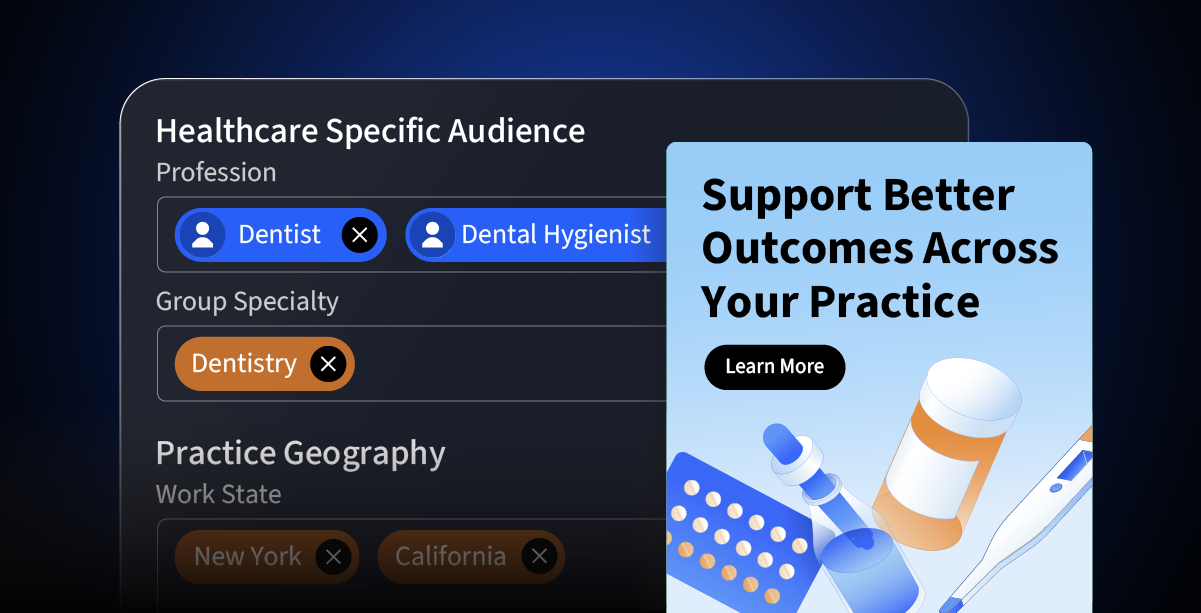
NPI targeting is a way for healthcare marketers to deliver ads directly to HCPs using the NPI as the identity anchor. Instead of relying on broad audience segments or inferred behavior, NPI targeting allows marketers to connect with specific, verified healthcare professionals at the individual provider level while remaining privacy-safe.
That’s what differentiates NPI targeting from traditional targeting approaches. Rather than targeting something broad, like “doctors in California,” NPI targeting makes it possible to reach specific professionals based on verified attributes such as their specialty, subspecialty, hospital affiliation, or treatment focus.
In doing so, NPI targeting unlocks true 1:1 engagement in healthcare marketing, allowing marketers to tailor messaging based on each HCP’s unique role, environment, and clinical focus, rather than casting a wide net and hoping the right professionals see the message.
NPI targeting is commonly used by pharma brands launching new drugs or expanding existing indications, medtech companies targeting surgeons or specialists for device adoption, and healthcare organizations focused on referrals or partnerships.
In areas like oncology, rare disease, or procedure-based specialties—where provider audiences are often small and wasted spend can add up quickly—NPI targeting gives marketers a way to reach relevant HCPs with more accuracy, clarity, and control.
How NPI Targeting Works
NPI targeting starts with building or acquiring an NPI target list. These lists are typically created using a combination of 1st-party data, 3rd-party data, or a mix of both, and include key provider attributes such as specialty, subspecialty, credentials, and practice location. In some cases, lists may also incorporate 3rd-party claims-based signals—like prescribing or referral patterns—to help marketers better understand which HCPs are most relevant to their message.
Once a list is in place, marketers segment it based on campaign goals. Rather than working from static lists, NPI targeting supports more dynamic, data-driven segmentation—such as specialists treating specific patient types, professionals who are likely to encounter a target case type, or, in some cases, high-volume prescribers. This ensures campaigns stay focused on the HCPs most likely to benefit from, engage with, or act on the information being shared.
From there, NPIs are matched to digital identities using deterministic identity resolution, allowing campaigns to activate NPI-based audiences programmatically across other digital channels. As campaigns run, teams can optimize them in real time, shifting budget toward higher-performing NPIs, refining segments, and adjusting sequencing or messaging based on performance.
Benefits of NPI Targeting
NPI targeting gives healthcare marketers a more precise way to plan, activate, and measure campaigns, helping teams understand not just who they reach, but how their efforts perform at the HCP level.
Here are some of the key benefits of using NPI targeting:
Precision Without Waste
NPI targeting helps marketers reach specific, high-value HCPs instead of broad, loosely defined audiences. By focusing on verified professionals, campaigns reduce wasted impressions and direct spend where it has the greatest impact.
More Relevant, Personalized Messaging
Because NPI targeting works at the individual provider level, marketers can tailor messaging to an HCP’s specialty, role, and practice context (and, where available, treatment or prescribing patterns). This approach makes campaign messaging feel more relevant and purposeful, increasing engagement.
Clear, Provider-Level Measurement
With NPI targeting, marketers can see exactly which HCPs they reached and how those professionals interacted with a campaign—whether they clicked on an ad or simply saw it. This level of visibility and granular campaign reporting helps teams understand what’s working, refine messaging, and inform follow-up efforts, including retargeting campaigns and sharing performance insights with field reps to support more informed outreach.
Consistent, Cross-Channel Reach
Through programmatic platforms like StackAdapt, NPI targeting lets marketers reach the same verified HCPs across display, native, audio, video, and connected TV (CTV) advertising channels. This consistency reinforces messaging as professionals move between devices and online touchpoints throughout their day.
Built for a Privacy-First Future
NPI targeting relies on verified provider identifiers, making it privacy-safe. It’s also a future-proof alternative to cookie-based targeting, which is increasingly important as regulations tighten and identity frameworks continue to evolve.
NPI Targeting Strategies for Healthcare Marketing
Once an NPI target list is in place, how and where you activate it matters just as much.
Here are a few strategies healthcare marketers should follow to build credibility and reach HCPs more effectively.
Meet HCPs Where They Spend Most of Their Time
The days of relying primarily on print-first outreach are over.
According to a study by M3 MI, the average HCP only spends about 16% of their weekly professional education time reading print resources to keep up to date with clinical research and industry developments.
Unsurprisingly, HCPs prefer walled-garden communities for trusted education on new medical information on diseases and treatments, collaboration, and peer-to-peer advice.
But like other knowledge-based professionals, HCPs are increasingly splitting their attention across other digital channels outside of endemic environments:
- According to M3 MI, many physicians turn to webinars, online medical videos, and podcasts to stay informed, with 59% saying these formats help them keep up with professional and clinical information.
- Video plays a central role in how doctors consume medical content, with a 2024 Wolters Kluwer study finding that 82% watch professional videos on YouTube.
- Audio content continues to gain traction among HCPs, with the same study finding that 56% of physicians cite Apple Podcasts as the most-used platform for healthcare-related podcasts.
To keep pace with this shift, marketers should use these channels to deliver clinically-relevant content when professionals are already seeking information, rather than trying to reach HCPs using outdated formats.
Only Share Evidence-Based Information
HCPs expect sponsored content to meet the same standards as the clinical information they rely on in their day-to-day work.
According to the same Wolters Kluwer survey, although HCPs are open to professionally relevant sponsored content, what’s said and where it appears matters, with the majority (48%) saying its value is diluted when it appears on public social media platforms.
To support promotional claims, marketers can strengthen the credibility of sponsored messages by not only choosing the right channels but including objective, evidence-based research, referencing multiple trusted sources, and citing clinical data, rather than relying on vague claims or superlatives.
For time-pressed HCPs, EMARKETER recommends using easy-to-scan tables and charts in ad creative to spotlight key data, short-form videos featuring insights from key opinion leaders to add clinical context, and ads on niche industry podcasts for education instead of direct promotion.

Programmatic Advertising Trends to Watch in 2026
Use CTV to Reach the Right Audiences
As previously mentioned, increased federal pressure is prompting healthcare marketers to scale back linear TV ad spending, which is expected to decline by 13% year-over-year in 2026 and a further 10.5% in 2027.
Explaining conditions, treatment options, and safety information often requires more than a 15- or 30-second spot, and growing pressure to clearly disclose risks and side effects is only pushing ad lengths longer.
As linear TV becomes less viable, many healthcare and pharma marketers are shifting budgets toward CTV, where they have greater control over who sees an ad and when.
When combined with NPI targeting, CTV allows marketers to move beyond the broad, demographic-based buys typically associated with linear TV advertising and engage more relevant, verified audiences.
Turn NPI Measurement Into Action
NPI measurement gives healthcare marketers a clearer view into what’s working at the provider level.
Instead of relying solely on aggregate metrics, teams can see which NPIs were reached, how they interacted with specific messages, and where engagement dropped off. This makes it easier to evaluate performance across channels, compare creative approaches, and adjust budgets or messaging based on real HCP behavior.
That visibility also supports more effective retargeting across digital channels. Because marketers can identify exactly which professionals interacted with an ad, they can build audiences around those high-intent professionals and re-engage them using a multi-channel approach to reinforce key messages.
NPI-level measurement also helps marketers identify which professionals are already engaging with your content, making it easier to plan follow-ups with field teams.
A study found that sales rep calls are 30% more likely to drive a prescription when they’re followed by exposure to a digital asset within 10 days. By pairing field activity with follow-up digital content, marketers can keep their brand and messaging top of mind while supporting more effective rep outreach.
Putting NPI Targeting Into Practice
As access to professionals becomes more limited and channels continue to fragment, precision matters more than ever.
NPI targeting gives healthcare marketers a more precise way to reach HCPs, tailor messaging to specific provider needs, and measure impact at the individual level.
But that precision only works if you can use it across the channels where HCPs actually spend their time.
Platforms like StackAdapt make it possible to build and activate deterministic NPI audiences directly within programmatic workflows, allowing marketers to orchestrate and measure campaigns across CTV, display, native, audio, and video, all in one place.
To learn more, speak with our team.

Content Marketing Manager
StackAdapt