



What is DOOH advertising? Definition, benefits, and examples

TL;DR: What is DOOH?
- Digital out-of-home (DOOH) advertising is defined as advertising delivered through digital signage in public, high-traffic areas.
- DOOH advertising offers better targeting, flexibility, and creative options than traditional static billboards.
- US DOOH ad spending is projected to grow nearly 35% from 2025 to 2029, significantly outpacing traditional OOH.
- DOOH seamlessly integrates with omnichannel marketing strategies, driving higher engagement and improving cross-channel attribution.
- AI-driven advancements, retail media, and CTV advertising are turning DOOH into a proven performance marketing channel.
Today’s digital advertising primarily focuses on connecting with consumers across all their devices. But not every part of your day is spent in front of a screen.
Maybe you drive or take the subway to work. Sometimes, you might hit up a convenience store for a quick, midday snack. After work, you may go to the gym, grab food at a grocery store, or attend an event or restaurant with some friends.
DOOH advertising aims to capture your attention during all of these offline moments (and more), helping you reach the right audience at the right place and time, even when they’re away from their computers or not actively looking at their personal devices.
In doing so, DOOH advertising effectively bridges the gap between online and offline experiences, ensuring brands stay top-of-mind throughout consumers’ daily routines by reaching them in the physical world.
In this blog post, we’ll explain what DOOH is, share some of its key advantages over traditional outdoor advertising, and explore a few ways you can leverage it as part of an omnichannel strategy to improve the performance of your digital campaigns.
What is DOOH advertising?
DOOH advertising is a modern form of advertising that uses digital displays to deliver DOOH ads to audiences in high-traffic areas, such as shopping malls, bus stops, airports, elevators, and other public spaces. It provides marketers with the flexibility, efficiency, and precision of digital advertising with the viewability, scale, and reach of traditional out-of-home (OOH) advertising.
What’s the difference between DOOH vs. traditional OOH advertising?
DOOH shares many similarities with traditional OOH advertising: both aim to reach large audiences in public spaces, capture attention with visually compelling messages and imagery, and enhance brand visibility and awareness.
However, unlike traditional outdoor advertising, DOOH is highly adaptable. It employs digital screens, such as LED displays, interactive kiosks, and digital billboards to deliver ads that can be updated and adjusted in real time. The types of locations where ads are displayed—like gas stations, gyms, and public transit—are mostly the same, but how they’re delivered is entirely different.
DOOH advertising also leverages geofencing, data analytics, and advanced targeting to reach the right consumers with relevant content based on location, time of day, local weather conditions, and more. This makes it a powerful channel for marketers to engage with consumers during transitional moments throughout the day when they’re on the go or away from personal internet-connected devices.
Because of its increased programmatic capabilities, improved measurement, and ability to serve multiple ad creatives in a single placement through dynamic ad rotation, the Out of Home Advertising Association of America (OAAA) says that DOOH advertising is becoming “an increasingly attractive option for major brands,” providing them with more flexibility than traditional static billboards.
In fact, according to a recent report from the World Out of Home Organization, digital formats will account for 49% of worldwide OOH advertising revenue in 2026, up from 31% in 2020—proof that DOOH is no longer an experimental channel but an important part of ad campaigns.

The State of Programmatic Advertising 2027
What are the benefits of DOOH advertising?
According to Steve Nicklin, Senior Vice President of Marketing & Analytics at the OAAA, DOOH is the “largest driver” of OOH ad spending.
Unlike other forms of traditional media, DOOH isn’t completely poaching the audience of traditional OOH advertising. Instead, rapid growth in DOOH spending is driving OOH to new heights. OOH ad spend in the US is expected to hit $13.2 billion USD by 2030.
During that time, US DOOH ad spending will grow from $5.11 billion USD in 2026 to $6.8 billion USD in 2030—representing a 33.1% increase—while traditional OOH ad spending will remain mostly steady during that same period, dropping a mere 0.1%.
Although traditional OOH advertising still accounts for the majority of ad spend, DOOH is increasingly used by marketers to connect with consumers due to the many benefits of DOOH advertising, including:
- Advanced targeting: DOOH provides precise and flexible targeting, allowing advertisers to cast a wide net or go super granular with their targeting and tailor messaging based on the location, time of day, and which demographics will likely see an ad.
- Flexibility: With DOOH, you don’t have to send someone to tear down a poster or install a new billboard when you want to make a change. Advertisers can use a programmatic advertising platform to swap out creatives and adjust campaigns in real time without stepping foot on-site.
- Dynamic content: Unlike traditional OOH, which is static, DOOH can use videos, animations, and other interactive elements to engage consumers. A 2024 study found that over one in five DOOH ads on video-capable screens were video ads, many of which were originally connected TV (CTV) ads, making it easy to repurpose creatives.
- Viewability: Because DOOH ads are often larger than display or CTV ads and are shown in public spaces, they’re harder to ignore. Adblockers don’t work in the real world, and the only way to skip them is by looking away from them, making DOOH ads more likely to gain viewers’ attention.
- Privacy-friendly: Unlike other types of digital channels, DOOH doesn’t rely on personal identifiers to deliver relevant messaging. Instead, it uses contextual signals—like weather conditions and nearby local events—to target ads. This privacy-first approach makes DOOH a smart choice for brands looking to engage audiences, especially in our increasingly cookieless future.
- Favorability: According to a study by the OAAA, 73% of US consumers view DOOH ads favorably—that’s higher than video (50%), social media (48%), online (37%), audio (32%), and print (31%) ads.
- Actionable: DOOH ads are particularly effective at driving foot traffic. In a study, 51% of people who noticed a DOOH ad with directions to a nearby store visited the business, and 93% of those who visited completed a purchase.
- Trustworthiness: According to EMARKETER, 80% of millennials and 77% of Gen Zers say that ads they can see in person, such as DOOH ads, seem more trustworthy than ones they see on their personal devices.

Level up your DOOH ads
DOOH ad formats and inventory types
There are three main formats to consider when deciding which type of DOOH ad is best for your DOOH campaign.
Large format
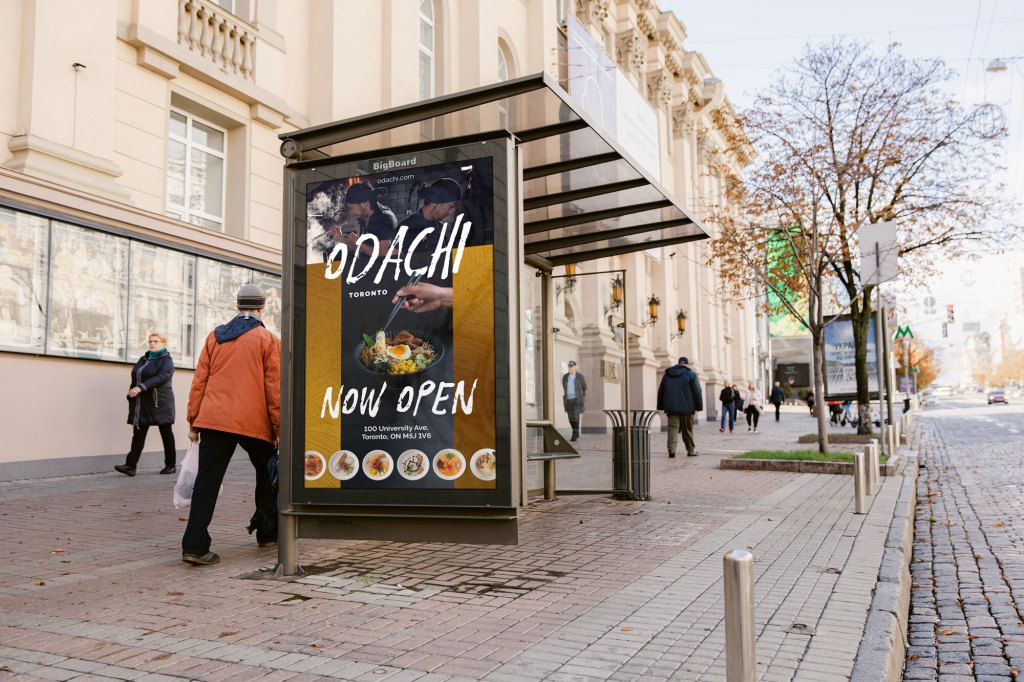
Due to their sheer size and scale, large-format DOOH ads are known for building brand awareness by reaching as wide an audience as possible in high-traffic areas.
When you think about large-format DOOH ads, the first thing that probably comes to mind is a gigantic billboard in Times Square, Picadilly Circus in London, or Yonge-Dundas Square in Toronto.
But aside from downtown cores in major cities, large format DOOH ads are also commonly found on:
- Billboards along the side of highways.
- Bus shelters and other transit waiting areas (for example, a subway or train platform).
- Walls on skyscrapers and other buildings.
Large-format DOOH ads are effective for generating broad brand awareness, major product launches, or any campaign that requires a large canvas to convey its message and leave a lasting impression.
Need proof? In 2026, transit was the fastest-growing segment of OOH advertising for a second consecutive year, rising 9.2% YoY—proving that large format DOOH remains a powerful tool for capturing attention in high-traffic, commuter-heavy environments.
Here’s an example of a large-format DOOH ad designed by StackAdapt’s in-house Creative Studio team:
Place-based
Much like real estate, place-based DOOH ads are all about location. They’re strategically placed in venues or environments that are contextually relevant to the target audience.
These include:
- Gyms
- Shopping malls
- Gas stations
- Office buildings
- Restaurants and bars
- Colleges and universities
The main goal of place-based DOOH ads is to increase purchase intent by tailoring and targeting ads that are relevant to each specific location, boosting brand awareness and the likelihood of a conversion.
For example, a DOOH ad at a gym would be a great location to market workout apparel and health and wellness products, such as a new running shoe or electrolyte mix.
Meanwhile, a DOOH ad at an EV charging station would be the ideal place to promote scheduling a tuneup at a dealership or grabbing a bite to eat at a nearby restaurant.
Because place-based ads appear in settings where consumers are often likely to spend a significant amount of time, they’re an effective tool for highly-targeted campaigns and brand storytelling.
Point-of-purchase
These DOOH ads appear in real-world locations like grocery stores, convenience stores, pharmacies, gas stations, and big-box retailers. True to their name, these ads are generally placed near points of purchase, encouraging customers to pick up an item before heading to checkout. These include:
- Store entrances
- Checkout aisles
- End caps and shelving
Because point-of-purchase DOOH ads appear in-store, they’re generally most effective for consumer packaged goods brands that want to sway customers towards impulse buys and last-minute purchases.
DOOH targeting and capabilities
Although DOOH advertising takes a one-to-many approach to reach a wider audience, it still provides targeting capabilities similar to other forms of digital advertising, ensuring marketers only serve ads where they’re contextually relevant.
Location-based targeting
Geotargeting, geofencing, and proximity-based targeting are all location-based advertising strategies that can be used for increasingly granular targeting.
For example, retail marketers could use geotargeting to target ads highlighting regional sales to cities in particular states. Another example could be a B2B marketer using geofencing and proximity-based targeting to serve ads on billboards near or within a specific radius of an industry conference.
Weather-based targeting
This targeting strategy allows advertisers to adjust their ad content and placements based on the current or forecasted weather conditions in a particular location where an ad appears.
For example, a winter tire brand could target areas about to experience their first heavy snowfall of the year. On the other hand, an alcohol company could use triggers to show ads only when a location reaches a specific temperature that signals the start of summer.
Listen to this podcast to learn more about weather targeting.
Time-based targeting
Also known as dayparting, this targeting strategy involves segmenting the day into different parts (or “dayparts,” such as the morning, afternoon, evening, and night) and targeting specific ads to audiences that are most likely to be receptive to certain messages during those times.
For example, a DOOH ad promoting a nearby coffee chain would be more effective during the early morning commute than after dinner when most people are getting ready for bed. Similarly, a DOOH ad directing consumers to a nearby bar for a nightcap would do better in the evening than at the crack of dawn.
Omnichannel integrations
DOOH seamlessly integrates with digital marketing channels like social media, mobile, and CTV advertising, increasing overall campaign effectiveness.
A study found that 47% of consumers search for social media handles featured on OOH ads after seeing them, and 40% share related content online—making DOOH ideal for driving online engagement and fueling retargeting across other digital channels.
For example, StackAdapt client Octopus Energy used native and display ads to retarget users who viewed their DOOH ads, generating nearly 3 million impressions and over 1,000 conversions.
DOOH measurement and analytics
Historically, traditional OOH advertising relied on imprecise data to gauge the impact of campaigns.
However, because DOOH advertising is connected to the internet, advertisers can measure DOOH ads with a higher level of accuracy. Many DOOH platforms use built-in sensors that track the number of unique devices passing by an ad to create accurate estimations on reach (how many people saw a DOOH ad) and impressions (how many times an ad was seen).
Another way to measure the impact of a DOOH campaign is through a brand lift study. In a brand lift study, both an exposed group (people who have seen an ad) and a control group (those who haven’t) are surveyed, and their responses are compared. The difference between the two groups is used to understand the “lift” generated by the DOOH campaign.
Brand lift studies are particularly helpful for measuring ad recall, brand awareness, consideration, and purchase intent.
Advertisers can also use footfall attribution, which tracks and analyzes foot traffic in real-world locations like brick and mortar stores using device IDs and other data, to tie in-person visits back to specific DOOH campaigns and understand the impact of offline advertising.
In the future, DOOH measurement will become even more sophisticated.
Speaking with EMARKETER, Anna Bager, president and CEO of the OAAA, said that “attribution models will evolve to better account for the impact of OOH advertising on overall marketing goals, providing a clearer understanding of its contribution to sales and conversions.”
An example of DOOH advertising in action
Now that you understand how DOOH advertising works let’s consider a hypothetical scenario that ties together everything we’ve learned.
For example, let’s say you’re a travel marketer promoting a ski resort.
First, you could choose an ad you’re using for your CTV marketing strategy and repurpose it for your DOOH travel campaign.
Next, you want to choose where and when the ads are displayed.
Going to a ski resort can get pricey, so you want to target areas where you know people have a certain level of disposable income. You also want to target people most likely to resonate with an ad campaign promoting fun and relaxation in the great outdoors.
With that in mind, you could target office workers in downtown cores, displaying your DOOH ads in high-traffic areas like bus stops, subway stations, and airports. Your DOOH ads could also be timed to display during the evening commuter hours at the end of busy workdays when a trip to a ski resort would seem even more enticing.
Because travelers like to book their vacations three to six months in advance, and January and February are generally considered the best months to hit the slopes, you probably want your DOOH campaign to begin between July and December of the previous year.
Finally, you want to measure the results of your DOOH campaign. You could use a brand lift study through a demand-side platform (DSP) like StackAdapt to measure its effectiveness at increasing brand awareness for your target audience and gauge the likelihood of them booking a stay.
That’s just one idea. Like everything in programmatic advertising, the options are seemingly endless.
DOOH advertising case studies
Ready to see some real-world examples? Here’s how some brands are using DOOH to drive awareness, engagement, and performance through StackAdapt.
Elevating brand awareness across Germany
To increase visibility for Michael Kors Jewelry, MOBSTA used premium DOOH placements in airports, malls, and luxury shopping districts. The campaign generated 14 million impressions and delivered a 39% increase in brand lift in Berlin and a 13% increase in Hamburg.
Reaching the right crowd for an Australian store launch
To support the opening of its new Sydney location, Mejuri used prominent DOOH placements at a high-traffic shopping center to build local awareness and encourage store visits. Carefully timed messaging, strategic screen selection, and display retargeting delivered 1.9 million impressions at a cost of just $36 AUD per mille.
Premium programmatic strategy delivers major surge in web traffic
Urban Sports Club focused its campaign on Cologne’s business district, using a mix of native, display, and DOOH formats to connect with audiences when they were most active. The combination of high-quality inventory, precise targeting, and engaging creative resulted in 9.83 million impressions and a 50% increase in web traffic.
Powering performance with a full-funnel DOOH strategy
Octopus Energy reached people across six of Spain’s largest cities with DOOH messaging designed for commuters and urban residents. After encountering the ads, users were retargeted through additional programmatic advertising channels, helping the campaign generate 3 million impressions, achieve a 1.34% average CTR, and drive more than 1,000 conversions.
Inspiring travel intent through high-impact airport screens
Digital Willow placed Visit Isle of Man messaging in airports across the UK and Ireland, reaching travelers at key moments in the journey-planning process. The campaign increased search click volume by 263%, showing how airport DOOH can build interest and influence travel decisions.
Brewing brand growth with DOOH and multi-channel precision
To help Ramsbury compete in the premium spirits category, Somebody Digital combined DOOH advertising near luxury retail outlets with retargeting across multiple digital channels. The approach generated 32.4 million impressions and drove 99% growth in website traffic, bringing the brand close to doubling its online visits.
The future of DOOH advertising
Along with its record-breaking growth, DOOH as a medium is also undergoing a major shift due to recent advancements in the industry. Based on recent trends, here’s what we predict for the future of DOOH.
AI streamlines DOOH campaign management
AI is impacting everything in marketing, and DOOH is no different. There are many ways that AI is changing and improving the way DOOH is bought, measured, and implemented.
AI is enhancing programmatic DOOH buying by making it faster and more precise with real-time bid optimization, contextual targeting, and omnichannel integrations.
AI is also changing how DOOH performance is measured. AI-powered attribution tools can measure foot traffic, retail lift, and conversions, delivering more accurate and faster results. Ads can be adjusted in real-time based on faster reporting, rather than forcing advertisers to wait for monthly or quarterly reports to make updates.
Furthermore, AI is changing how DOOH ad creative get made. Rather than replacing human artists, AI can be used to implement different creative iterations based on contextual triggers like weather conditions, time of day, and popular local events—making messages resonate more strongly.
DOOH increases engagement and attribution with mobile
There are countless examples of innovative DOOH ads that think outside the box, from coughing billboards with built-in smoke detectors to mind-bending 3D experiences that cause you to do a double-take.
But, it doesn’t have to be that complex.
In 2025, the OAAA’s SVP of Marketing & Analytics told EMARKETER that the humble QR code will play an increasing role in DOOH ads, providing consumers with information on products and services while giving advertisers data they can leverage for future campaigns and reporting.
“Out-of-home is big screens driving consumers to small screens,” he said. “What those devices also really open up and allow is measurement of audience movement and patterns.”
Advertisers looking for deeper insights can tap into the added layer of interactivity that mobile engagement brings. Scannable QR codes and similar mobile touchpoints allow brands to capture first-party data, track engagement, and understand how many consumers interact with a DOOH ad after exposure. This data can then be aggregated to inform future creative, optimize targeting, or be integrated into data platforms to enhance measurement and performance across other marketing channels.
Retail media drives the next wave of DOOH growth
Retail media is poised to become a significant force in the future of DOOH advertising, especially as brands look for ways to engage shoppers closer to the point of purchase.
In-store retail media ad spending is projected to increase from $630 million USD in 2026 to $1.26 billion USD by 2030. During that time, DOOH’s share of in-store ad spending is expected to grow from 12.2% to 18.6%, highlighting the growing importance of retail environments within the wider DOOH landscape.
Digital signage in grocery stores and other retail environments allows brands and advertisers to reach high-intent shoppers during critical decision-making moments. According to Grocery TV’s In-Store Shopper Perception Report, 62% of US grocery shoppers have purchased a product immediately after seeing it advertised on an in-store screen, while 37% say in-store ads help them discover products they might not have otherwise known about.
The location of these screens also plays an important role in how shoppers respond to advertising. DOOH ad placements in apps, at checkout lines, near delis, inside store entrances, and in pharmacies were among the most accepted and positively received formats.
These environments can give brands an opportunity to influence impulse purchases, promote last-minute additions, and engage consumers during periods when they’re already close to making a purchase, introducing consumers to new products and brands.
At the same time, these campaigns create opportunities to capture valuable consumer insights, helping advertisers refine their messaging, deliver more contextually relevant experiences, and build stronger brand loyalty—making it a win for both consumers and brands.
The line blurs between CTV and DOOH
Digital screens and DOOH software are increasingly being installed on gas station pumps, airplane seat headrests, and in restaurants and retail stores, allowing marketers to engage audiences in public spaces with the same level of targeting, personalization, and engagement as CTV advertising.
Whether you call it OOH TV advertising, CTV OOH advertising, DOOH advertising, or something else entirely, these ads look and feel just like the types of CTV ads you’d watch while streaming Disney at home, but often come at a lower price than traditional CTV ads.
Part of that has to do with the amount of scale and inventory available. Unlike traditional CTV, scale and targeting are limited, with ads appearing in fewer locations and seen by fewer people compared to ads served through streaming services. But this limitation also creates a valuable opportunity to hyper-target based on context and location, making it perfect for highly relevant messaging in specific physical environments.
For example, ads served on airplane seat screens during flights to sunny vacation spots could feature local tourism activities, hotel deals, or car rentals at the destination.
Local advertisers further embrace DOOH
As local advertisers increasingly look for ways to reach consumers in specific communities, they’re turning to DOOH advertising.
By providing broad visibility, geographic precision, and flexible campaign management, DOOH advertising is particularly valuable for local businesses such as retailers, restaurants, real estate companies, and travel brands that want to connect with audiences near their stores, venues, or service areas.
As a result, according to BIA Advisory Services, the US local advertising market will reach $184.5 billion USD in 2026, with digital channels accounting for half of that spending (driven primarily by growth in CTV and programmatic DOOH).
DOOH can help local advertisers build awareness across high-traffic areas while using audience, location, and contextual data to make campaigns more relevant.
As programmatic buying and dynamic creative become more advanced, local businesses will be able to adjust messaging based on factors such as store proximity, time of day, weather, and local events—bringing the flexibility of digital advertising into the physical world.
Programmatic DOOH grows in popularity
In the past, advertisers had to either deal directly with media owners using traditional insertion orders or use DOOH-specific DSPs to get their ads on digital billboards.
Now, platforms like StackAdapt simplify the process by bringing everything together under one roof, making it easier for advertisers to launch, adjust, and track the impact of DOOH ads and multi-channel campaigns.
With programmatic DOOH ad spending forecasted to grow 22.6% in 2025 and reach $1.35 billion USD by 2027, the future looks promising for advertisers and consumers alike.
Ready to experience the power of StackAdapt’s programmatic DOOH advertising solutions? Request a demo today.
DOOH advertising FAQs
OOH advertising captures the attention of people on the go, reaching audiences in public spaces where they typically spend a significant amount of time. It enhances brand visibility and complements digital campaigns by providing a physical presence offline.
DOOH advertising is highly effective. A study reported that DOOH advertising can increase spontaneous advertising recall by 17% when content is contextually relevant to the viewer.
DOOH advertising is better for targeting, flexibility, dynamic creatives, and more accurate measurement. That said, traditional OOH still works well for agencies and brands looking to achieve broad, consistent visibility and deliver long-term branding campaigns. Combining both is ideal for maximizing reach and engagement.
Yes, DOOH is perfect for local ad campaigns. Advertisers can use geofencing and location-based targeting to reach specific neighborhoods, cities, or regions, helping ensure ads are relevant to each location and drive local foot traffic.
DOOH ad costs vary depending on location, screen type, ad duration, audience, and campaign length. Generally, CPMs for DOOH range from $2 to $15 USD. But premium locations or formats often demand higher prices.
To calculate CPM for DOOH, divide the total cost of the ad campaign by the number of impressions in thousands. This metric helps assess the cost-effectiveness of reaching a thousand viewers.
DOOH stands for digital out-of-home advertising. It uses internet-connected digital screens in public, commercial, and transit spaces—such as billboards, airports, shopping centers, gyms, and retail stores—to deliver dynamic ads that, unlike traditional OOH advertising, can be updated without requiring in-person installation.
Neither is inherently better. The right choice depends on the campaign’s objectives, budget, location, and need for flexibility. Traditional OOH works well for sustained visibility, while DOOH is better suited to time-sensitive campaigns that require changing messages, contextual triggers, or the efficiency and scale that comes with programmatic buying.
DOOH is traditionally considered offline marketing because ads appear in physical, shared environments rather than on personal devices. However, its connected technology, programmatic buying capabilities, and dynamic creative make it a hybrid medium that can complement digital channels such as mobile, social, and CTV advertising.
Dynamic content triggers use automated data feeds and pre-set rules to change the creative shown on a screen based on real-world conditions. Campaigns can respond to factors such as weather, time of day, traffic, sports scores, transit updates, local events, or audience mobility patterns.
DOOH builds broad awareness in the physical world, while social media provides more opportunities for direct action. Brands can coordinate their messaging by using DOOH to reach people near relevant locations and use social ads to promote the same offer, event, or call to action later on their mobile devices to build brand recognition and encourage direct interactions.
Advertisers use a DSP like StackAdapt to bid on and purchase inventory connected to participating screen owners through supply-side platforms or ad exchanges. They select locations and inventory, apply audience, scheduling, or contextual targeting, upload approved creative, set budgets and bids, and monitor delivery once the campaign is live.

Written by
You may also like

What is programmatic DOOH and why it’s the future of OOH

Linear TV vs. connected TV: Differences, benefits, and strategies

CTV vs. OTT advertising: Key differences, examples, and how to use it