

The AI Advertising Podcast: S2
Episode 12
Can ChatGPT ads beat search? What marketers need to know now

About this episode
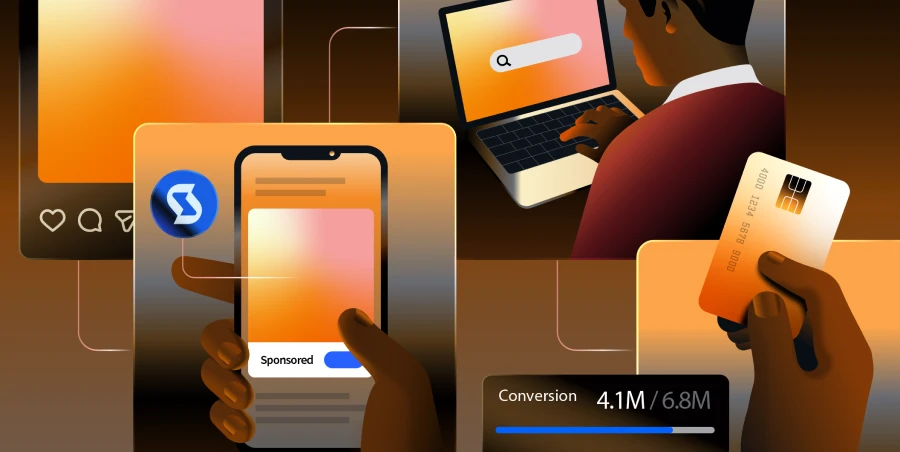
As advertising begins to enter ChatGPT, marketers face a new question: how should they think about AI conversations as a place for discovery, influence, and performance?
In this episode of The AI Advertising Podcast, we explore what ChatGPT Ads are, what marketers know so far, and how brands should approach this emerging channel.
Yang Han | Co-founder and CTO, StackAdapt
Michael Shang | SVP of Advertising Technologies, StackAdapt
Transcript
Diego Pineda (00:00:00)
Search advertising was built around a simple idea: when people type a query, they reveal intent.
But inside ChatGPT, that signal may be richer. Instead of a few keywords, users share context, constraints, goals, preferences, and follow-up questions. That is what makes advertising inside ChatGPT so interesting — and so uncertain.
What we know so far is still limited. Early tests suggest engagement is promising. At the same time, pricing is in flux, measurement capabilities are beginning to take shape, and the full-funnel playbook is not here yet.
In this episode, you’ll hear about an emerging channel that marketers need to understand early. LLM advertising.
You will hear two perspectives from Michael Shang, SVP of Advertising Technologies and Yang Han, Co-founder and CTO at StackAdapt.
The question before us is, can ChatGPT ads become a real new layer of commercial intent?
Let’s find out.
Podcast Intro (00:01:07)
Welcome to the AI Advertising Podcast, brought to you by StackAdapt. I’m your host, Diego Pineda. Get ready to dive into AI, Ads, and Aha moments.
Diego Pineda (00:01:22)
ChatGPT ads seemed like the inevitable next step in the evolution of Large Language Models or LLMs. But as an emerging channel, there are many unknowns. So, why does this matter now for marketers?
Michael Shang (00:01:36)
Well, that’s where the people are. So you want to follow where the people are and certainly you want to cater to their behavioral demand. That is, if they do want, for example, I mean, not sure how you use ChatGPT right now, but for example, let’s say I, who I’ve been really into playing hockey, and I want to go buy a pair of skates.
An LLM has the power to actually know quite well about you because you will actually, as part of the interaction process, you will say, hey, I got super wide feet or I have really large volume in terms of the height of my feet or I have this kind of feature about my feet. It captures all that nuance, right? And then basically recommend you pretty much exactly the pair of skates you want to buy. I think you will see quite a successful conversion rate on those purchases because the recommendation will be so good.
So that was the initial promise of search-based advertising. That is, if you’re searching for something, you’re disclosing intent. So an LLM is no different. You’re disclosing intent with way more information or continuation of understanding of the user.
Diego Pineda (00:02:41)
That is the core shift. Search captures a query. Conversation may capture intent with more depth.
Yang Han (00:02:48)
This goes back to the conversation of like, does AI compete with search or social? I would say it probably competes more with search. Because in social, people browse more not to discover information, but more for social aspects. But definitely it does compete with search.
We do believe, obviously, Google has their own AI solution, OpenAI is still heavily utilized when it comes to a standalone AI solution as well. And there could be a world in which both coexist. But definitely, I think the expectation is for OpenAI to become a performance-driven channel based on the data it has, based on the contextual relevancy.
Diego Pineda (00:03:44)
If ChatGPT ads are closer to search than social, what actually makes them different?
Yang Han (00:03:49)
AI and LLMs have a lot more potential to go way deeper. First of all, they have history, right, on your conversations, where search tends to be just in real time. So AI has context and history and deeper concepts. Usually you have a conversation with an AI, whereas in search, you just have like a few words or keywords. It’s not even a full sentence, right? But with AI, it can go a lot more deeper in terms of understanding intent.
What is the user actually trying to look for? And if you have data over time, you start to understand what’s unique about this individual. And then you can anticipate what they might need next or what could provide them the most value. So there’s a lot more potential, I’d say, in the long run. Search is already known as a pretty well-performing channel. But this can go deeper than search and also deeper than social. Because social is a lot of indirect associations based on what you’re browsing, what you’re engaging with. So you still have to do a bit of a correlation.
But with AI, there’s a lot more deterministic, but you have the history as well. So you kind of get the best of both worlds. So I think when it comes to advertising and marketing, and this as a growth channel for brands, it has way greater potential than any other channel we’ve seen on the market, essentially.
Diego Pineda (00:05:12)
That is the upside case in one answer: more context, more continuity, and potentially a much stronger understanding of intent than either search or social can offer on their own. Michael gets there from a more advertiser-centric angle.
Michael Shang (00:05:29)
It’s one of the first places that an ad opportunity exists. So when you think about the user behavior, and we typically call them the gatekeepers, basically that is large platforms where users go through to interact with content or the web.
And this is one of the largest gatekeepers in the world without ads. And they’re introducing that. And typically at that specific inflection point, as an advertiser, you start to see efficiencies because no advertising exists on this platform.
If you were to be the first one, you can expect it to perform super well. You’re capturing undivided attention from users, right?
So that’s why it’s a super experience. Number one is because this is one of the largest gatekeepers of user traffic in the world without an opportunity. Number two is that they’re opening up.
Diego Pineda (00:06:26)
Now here is where both guests get practical. The promise is big but the unknowns are still bigger.
Yang Han (00:06:32)
It’s still early. We’ve had some tests. Overall engagement looks good. They already have keyword-based hints for you to attempt to match as relevant as possible to the queries. But it’s going to be a journey for them to continue to optimize it, tie it to performance and have that whole flywheel essentially.New capabilities are being added almost every week. They’ve been adding new targeting capabilities, tracking capabilities, pacing budget and whatnot in very short order. So hopefully, in a not too distant future, later this year, we’re going to see a much more comprehensive solution end to end that will be competitive with other platforms out there like Meta and Google, let’s say in a year’s time or so.
Diego Pineda (00:07:15)
OpenAI has now launched conversion tracking, which gives advertisers an opportunity to start measuring outcomes and understanding how ChatGPT fits into their broader marketing and advertising strategy.
Michael Shang (00:07:28)
I think there are many variables. For example, how does the planning look like? What does the UI look like? What does the CPM look like? What are my requirements when it comes to creative assets? All those things, right? There are so many ifs and buts.
But fundamentally for advertisers, this is about efficiency. Am I spending money to make money? Am I doing that efficiently?
If I can spend a dollar and make — for example, ChatGPT is pricing their ads, for simplicity, let’s say $60 CPM — if I’m spending $60 CPM, but I’m getting massive ROAS on all the things I want to push out, well, I’m happy to spend that $60 CPM.
So I would say that’s the uncertainty: whether or not this will perform for me as an advertiser. A lot of this has to evolve.
Diego Pineda (00:08:38)
One of the most useful parts of Yang’s perspective is that he does not see LLM ads as only upper funnel or only lower funnel. He sees them as eventually flexible across the journey.
Yang Han (00:08:49)
I mean, in theory, you can do it across the board, right? If you’re introducing something new to a user, you always start with an awareness. And then as you hook people’s interest over time, you’ll go deeper into the research phase, and then you want to close them, right?
So I think it depends. Let’s say I’m an individual and I’m already actively — it’s already in my mind — to, let’s say, buy a new laptop. I’m already deep in that. Then you want to identify users in the later stage of this purchase journey. So you want to execute more of a strategy to close them, essentially.
But let’s say I completed this purchase and maybe there’s something else I may need next, such as a new keyboard, for example. You want to start with the likelihood based on what they’ve completed already, based on what they might need next. That’s more of a brand awareness. You’re starting to put that interest in your mind.
And then as they start to prove that yes, this is something I want to do more research on, that’s when you go hit them harder, essentially, to try to close them. So people are always at different aspects of their journey. It’s about first wanting to identify that.
And that’s where the strategy and the creative and the messaging has to differ based on that for every individual.
Diego Pineda (00:10:19)
That is a more nuanced view than just saying “this is the next search ad.” The long-term opportunity may be that conversational AI can support awareness, research, and conversion — but with different signals and different messaging at each stage.
Diego Pineda (00:10:39)
Even if ChatGPT becomes a major ad environment, it should not be managed in isolation.
Yang Han (00:10:45)
Well, I think a DSP will allow you to have a much more holistic strategy, right? So let’s say in the future, OpenAI does have first-party data capabilities, personalization capabilities that the DSP can hook into.
If you could just run only on OpenAI or run OpenAI and other channels independently, but they’re not going to talk to each other. You have the age-old problem of everyone attributing the same user, right? You don’t have really good visibility on where your results are actually coming from.
With the central source of truth, with a DSP that is hooked into every single channel, you should be able to, in one place, have much more holistic strategy, to push consistent audience strategies to all these different channels, drive personalized creatives across all these channels, and then have strong visibility.
You want to have seamless and integrated models when it comes to measurement to figure out where the results are actually coming from. Then you can optimize across all these different channels and allocate the budgets effectively across the board.
So you always want to start from a higher view because the users are always going to be across different channels in different places across the board. And the age-old problem was you don’t want to execute in isolation. You want to execute holistically.
Diego Pineda (00:12:10)
That is the orchestration argument. AI is just another high-intent environment inside a broader system.
Diego Pineda (00:12:22)
Recently, StackAdapt announced it’s offering access to advertising within ChatGPT, giving advertisers a way to start testing this new format through its platform.
So what does that mean in practice?
It means marketers have a chance to start learning how ads work inside ChatGPT while the space is still new. They can see how people respond in these conversational moments, what kinds of messages make sense there, and where ChatGPT might fit alongside search and the rest of their marketing mix.
The smart move right now is to test with a clear purpose. Use budgets that give you room to experiment. Look beyond last-click results and pay attention to signs like engagement, follow-on actions, and whether your category feels like a natural fit in these conversations. This is also a chance to start learning what kind of creative and messaging works best in an AI environment.
What StackAdapt’s access really offers is the chance to learn early.
And right now, that may be the biggest advantage.
If search helped marketers understand what people were looking for, AI may help them understand what people actually mean. And if that proves true, this will be more than a new ad format. It could become a new way to shape how people discover and choose.
Podcast outro (00:13:46)
Thanks for listening to this episode of The AI Advertising Podcast. This podcast is produced by StackAdapt. Visit us at stackadpat.com for more information about using AI in your advertising campaigns. If you liked what you heard, remember to subscribe, and we’ll see you next time.


